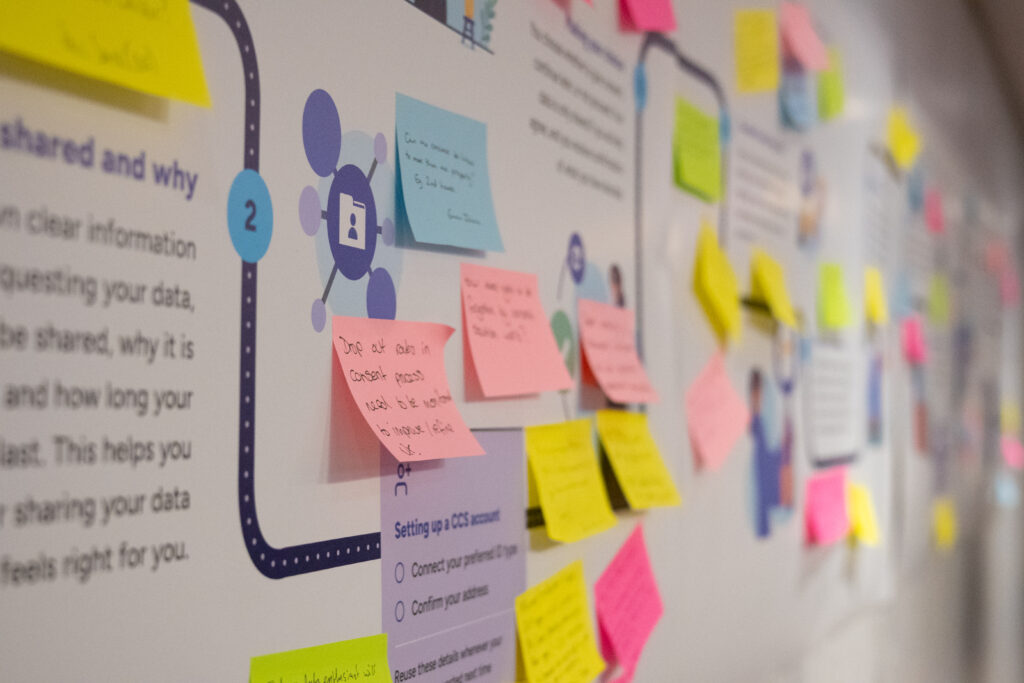
The event took place during the live CCS Design Consultation and brought together industry, policy, technical and consumer representatives to explore the proposed solution and share early feedback.
The session focused on practical engagement with the consultation proposals, helping stakeholders better understand the proposed design and how they can contribute to shaping a robust, consumer-centric solution.
Key themes:
The day aimed to support meaningful engagement with the consultation by providing;
- A clear overview of the Consumer Consent Solution design proposals
- Greater confidence for stakeholders responding to the Design Consultation
- A stronger foundation for ongoing collaboration with RECCo through design and delivery
Breakout Sessions:
Participants joined a series of practical breakout sessions covering key elements of the proposed solution.
Policy and consent design
The session outlined the proposed legal and REC policy framework for consent within the CCS. This included identifying the Consumer as the relevant data subject under the UK GDPR, who may grant, manage, and revoke consent to the sharing of half-hourly energy data. The session also covered proposed policy positions on how consumers access the CCS, minimum identity verification standards aligned to the Government Digital Service – Good Practice Guide 45 (GPG45), and baseline cybersecurity requirements for participating organisations
Technical design and delivery
This session focused on the proposed high-level technical architecture for accreditation and onboarding, IDV, data sharing, and consumer consent management, highlighting the key interactions between consumers, CCS users and the CCS technical solution. This also covered the proposal to adopt FAPI 2.0 as the security profile underpinning the CCS technical solution, as well as the proposal to require mutual TLS (mTLS) for data sharing between ATPs and EDPs.
User experience and consumer outcomes
This session focused on the proposed UX Framework, Behavioural archetypes, Disability matrix and Consent Lifecycle, considering how consent journeys can remain clear, accessible and consistent for consumers. Discussions also covered non-digital journeys and ensuring the solution supports consumers in vulnerable situations.
Governance and next steps
The session outlined the proposed delivery and operational framework, including funding, assurance, change control and issue resolution. We also shared the consultation timeline, key decision points and opportunities for continued stakeholder involvement.
What we heard:
The engagement day generated valuable discussion and feedback across several areas of the proposed design, including:
- The need to design CCS for the average consumer, not just those already highly engaged with their energy data.
- Discussion on identity verification (IDV) approaches and standards, including the potential for federated IDV so consumers do not need to repeat checks across services.
- Supporting real-life moments, such as switching supplier or moving home, while balancing data portability and good data hygiene.
- How CCS interactions should appear within ATP journeys, and how visible they should be to consumers.
- The value of a shared vocabulary for consent and different data types across the ecosystem.
- Interest in the policy rationale for controls on half-hourly consumption data.
- Questions around multi-occupancy households, including who the data subject is, who can grant or revoke consent, and when consumption data may be considered aggregated.
- The role of the consumer portal, including how to help consumers access consent records and understand the value of a central portal alongside ATP services.
- Questions about downstream data sharing, including what visibility consumers would have where data is shared with additional third parties.
- Discussion of MPxN matching, including the use of enquiry services and fallback options where address matching fails.
- Interest in cross-code interactions, particularly the relationship between CCS accreditation and existing SEC audit processes.
- Questions on the use of mTLS for data sharing between ATPs and EDPs, and the need to allow sufficient implementation time for organisations with existing infrastructure.
This feedback will help inform the next phase of CCS design development.
What’s next?
Thank you to everyone who attended and contributed their insights.
The Consumer Consent Solution Design Consultation remains open until 25 March 2026.
We encourage stakeholders to review the proposals and share their feedback.
Download the Consumer Consent Solution Design Consultation Pack, complete Annex A: Consultation Response Form, and email your completed response as a Word (.docx) file to consumerconsent@retailenergycode.co.uk by 17.00 on 25 March 2026.
Stay Involved?
Join CCS working groups
We continue to host regular Consumer Consent Solution working groups, including both general and topic-specific sessions, to support collaboration as the solution progresses through design and delivery.
Join our Consumer Consent Working Groups: Here
Stay updated
Sign up to the CCS Newsletter to receive the latest updates on the project and future engagement opportunities.
Engagement Day resources
We’ve also shared the resources requested during the event, including:
- Q&A follow-up with responses to questions raised on the day: Engagement Day Q&A
- CCS Engagement Day Presentation Pack
Download Consultation Pack